


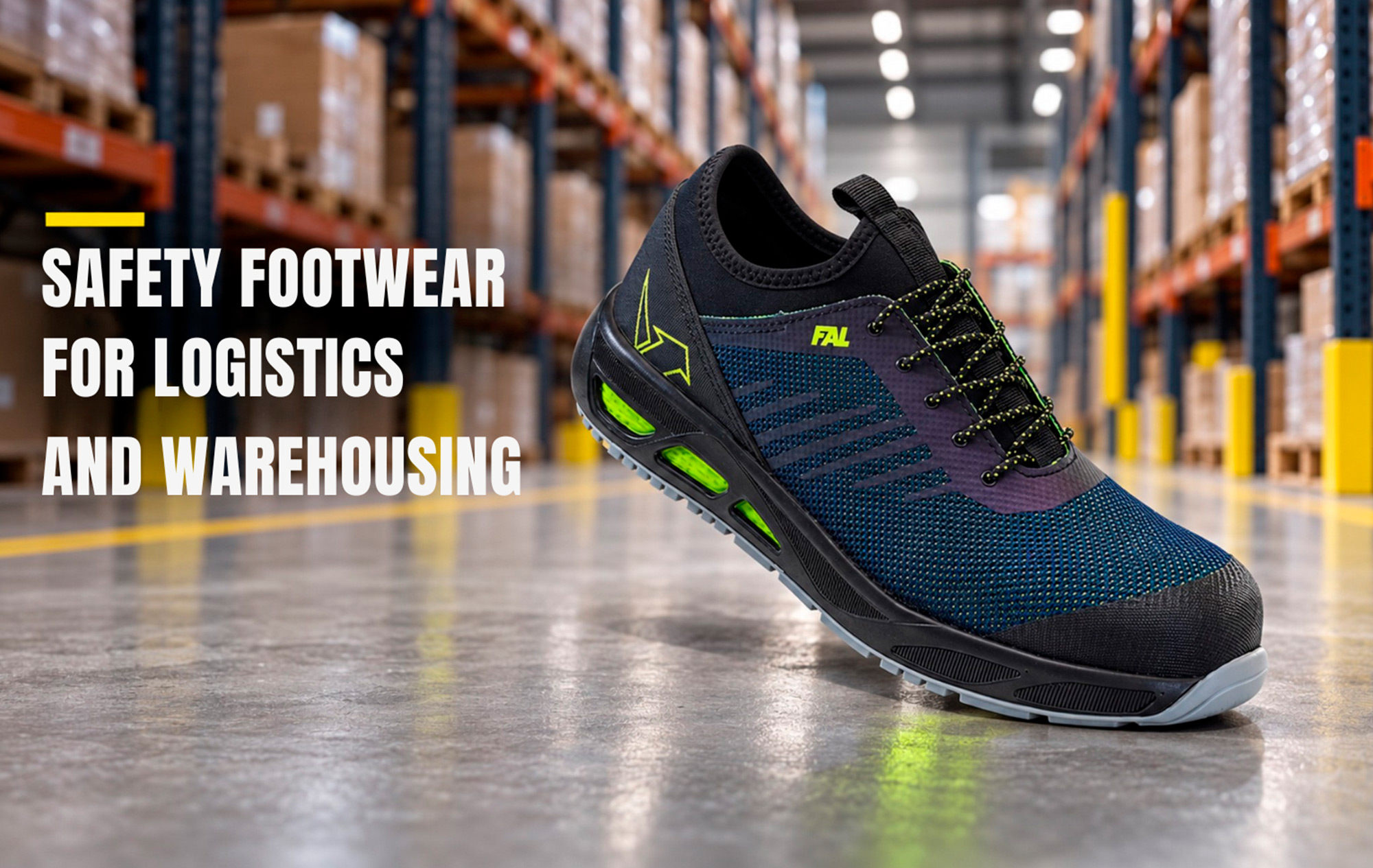
How to choose safety footwear for logistics and warehouse work: S3S protection, ESD, grip and comfort
In a warehouse, feet are subjected to a wide range of demands: walking long distances whilst picking, prolonged periods on one’s feet, repetitive movements, handling loads and moving around near pallet trucks or forklifts.
Added to these factors may be wet floors, temperature changes, small objects that could puncture the sole, and areas where electrostatic discharge needs to be controlled.
Therefore, choosing safety footwear for logistics is not simply a matter of looking for a specific category. The right model must address the risks identified for each role and provide a proper fit for the person wearing it.
Risk assessment: always the starting point
Two workers in the same warehouse may require different features. Someone preparing orders in a dry area does not face the same risks as someone working on loading bays, in cold stores or in areas with components sensitive to static electricity.
The selection of footwear must be based on an occupational risk assessment and take into account, amongst other factors:
- The possibility of goods falling onto the foot.
- Risk of compression.
- Presence of objects capable of piercing the sole.
- Condition and characteristics of the flooring.
- Presence of water, oils or hydrocarbons.
- Temperature of the workplace.
- The need to control electrostatic discharges.
- Distance covered and time spent on one’s feet.
- Compatibility with other personal protective equipment.
The footwear’s marking allows you to check which requirements have been tested, but it does not replace this prior assessment.
What does the S3S category mean?
The EN ISO 20345 standard sets out the requirements applicable to safety footwear fitted with a toe cap designed to protect against impact and compression.
In the Airfal models analysed, the non-metallic Vincap® toe cap offers protection against impacts of up to 200 joules and a compression resistance of 15 kN, according to their technical data sheets.
The S3S category combines several features of interest for certain logistics environments. These include a closed heel, antistatic properties, energy absorption in the heel, resistance to cutting and water absorption, and protection against punctures.
The final letter identifies the type of anti-puncture insert. In this case, ‘S’ indicates that it is a non-metallic protection tested with a 3-millimetre punch. The technical specifications for Airfal models state a puncture resistance of 1,100 N or more.
However, S3S should not automatically be interpreted as ‘the best footwear’ for any warehouse. It is a suitable category when a job assessment determines that such protection is necessary.
SR: tested slip resistance
Slips can be caused by numerous factors: the presence of liquids, dust, packaging debris, worn flooring or inadequate cleaning.
The SR marking indicates that the footwear has passed the additional slip resistance test on ceramic tiles with glycerine, as specified by the standard.
This feature is particularly important on loading bays, high-traffic areas and areas where the floor may occasionally be contaminated. However, no footwear can guarantee that a slip will never occur. The maintenance of the premises, the cleanliness of the floor and the condition of the sole remain essential.
Antistatic and ESD footwear: related but distinct concepts
This is one of the points that causes the most confusion.
The ‘A’ marking identifies footwear with antistatic properties. Its function is to dissipate part of the accumulated electrostatic charge and reduce excessive build-up.
The ‘ESD’ marking, on the other hand, refers to a more specific electrostatic dissipation capability, used within control systems designed to protect sensitive areas, equipment or components.
The Airfal models analysed are identified in their technical data sheets as ESD, with the ability to dissipate electrostatic charges. This feature may be relevant in electronic component warehouses, automated facilities or other areas protected against electrostatic discharges.
It is important to remember that antistatic or ESD footwear is not electrically insulating and must not be used as protection against contact with live electrical parts. Where there is an electrical hazard, specific equipment must be selected in accordance with the relevant risk assessment.
Furthermore, the effectiveness of an ESD system does not depend solely on the footwear. Consideration must be given to the combination of the wearer, the footwear, the flooring and the other electrostatic control measures in place at the facility.
Comfort during shifts involving a lot of walking
During picking or order preparation tasks, a significant number of steps can be taken over the course of a shift. Therefore, alongside protection, fit, stability, breathability and the performance of the sole must be taken into account.
The Airfal AF20GR and AF20W models feature:
- Water-repellent textile upper.
- Breathable, abrasion-resistant lining.
- TPU sole with polyurethane core.
- Rebound System®.
- Ergonomic polyurethane insole.
- Breathable, antibacterial, odour-resistant and removable insole.
- Self-adjusting sock liner and lace fastening.
These features are designed to provide functional footwear for prolonged professional use. However, comfort also depends on the anatomy of the foot, the size, the fit and the preferences of each wearer.
Before supplying a whole workforce, it may be advisable to carry out a trial with a representative sample of workers and gather their feedback.
Airfal models for different logistics needs
AF20GR and AF20W: a versatile option
The AF20GR and AF20W models share the following key features:
- EN ISO 20345:2022/A1:2024.
- S3S + CI + SC + SR + FO classification.
- ESD capability.
- Vincap® non-metallic toe cap.
- Textile puncture-resistant insole.
- Sole with Rebound System®.
- Breathable lining and insole.
- Sizes 35 to 48.
Given their design, they may be considered for selection in processes such as order picking, order preparation, moving around the warehouse or working on loading bays, provided that their performance characteristics match those set out in the risk assessment.
AF30BOAGR: adjustment via the BOA® Fit System
The AF30BOAGR incorporates the same regulatory classification and key protective features as the AF20.
The most noticeable difference is the BOA® Fit System fastening, which allows the fit to be adjusted using a dial. It may be a suitable alternative for roles where a quick-release fastening system that can be easily readjusted throughout the working day is required.
The upper combines water-repellent microfibre and water-repellent fabric, whilst the lining is breathable and abrasion-resistant.
AF10B and AF10W: Superfabric upper
The AF10B and AF10W also feature an S3S + CI + SC + SR + FO classification and ESD capability.
These models incorporate an upper made from water-repellent Superfabric, defined in Fal Seguridad’s documentation as a material with high mechanical strength. They may be worth considering when, in addition to the general performance characteristics, greater resistance of the outer material to environmental demands is required.
Additional features worth noting
The models analysed incorporate the following complementary classifications:
- CI: cold insulation in the sole.
- SC: abrasion resistance of the toe cap.
- FO: hydrocarbon resistance of the sole.
- WPA: cut resistance and resistance to water penetration and absorption.
- E: energy absorption in the heel area.
These features may be useful in certain warehouses, but their presence does not imply that the footwear is suitable for any extreme situation. For example, the CI marking does not automatically make a shoe suitable for cold stores: the temperature, exposure time and the overall outfit must be taken into account.
The importance of fit and maintenance
Proper protection starts with choosing the right size. The foot must be securely held in place, without excessive movement, but there must also be sufficient space in the toe area.
It is also advisable to check the following regularly:
- The tread pattern and wear on the sole.
- The condition of the toe cap and upper.
- The fastening and laces.
- The appearance of cracks or splits.
- Deformation of the insole.
- The presence of persistent dampness.
- Any punctures or damage sustained whilst working.
The original insoles form part of the configuration assessed by the manufacturer. Replacing them with a different type of insole could alter certain properties, particularly electrostatic behaviour. For this reason, only compatible and authorised replacement parts should be used.
Protection and comfort must go hand in hand
In logistics and warehousing, footwear accompanies the worker for practically the entire shift. It must protect against identified risks, but also offer a fit that facilitates movement and prolonged standing.
The Airfal range combines S3S protection, SR slip resistance, ESD capability, non-metallic components and comfort-focused solutions. Models such as the AF20GR, AF20W, AF30BOAGR, AF10B and AF10W offer different configurations based on a common technical foundation.
The final decision should not depend solely on the appearance of the shoe or on a generic category. It must be based on the risk assessment, the actual conditions in the warehouse and the needs of those who will be using it.
Because in logistics, every step is part of the job. And every risk must be met with the appropriate protection.